Product
Being asked for them should not be a problem
The question that decides an inspection is not how much you can be fined. It is whether you can show, today, what each person has worked over the last four years.
The reports
The report is already done when they ask
Working time by person
Day by day, with clock-ins, clock-outs, breaks and totals. It is the document the Inspectorate asks for during a visit.
Monthly summary
Totalled by person and month. The copy of the summary that art. 35.5 of the Estatuto requires to be handed over with the payslip when there is overtime.
Overtime
Separated by nature and by whether it is compensated with rest or paid, as article 3.f of the draft provides. Art. 35.5 of the Estatuto requires it to be recorded day by day and totalled.
Hours balance
The difference between the agreed working time and the time actually worked, by period. Using the criterion of your collective agreement.
Incidents
Missing clock-ins, working days left open, rest between shifts below the minimum and breaks left open.
Integrity check
It lets you check whether the entries of a period have been altered, without depending on us.
To print, sign or attach to a case file.
Excel
So that the advisory firm can match it against payroll.
CSV
To load into any other system without a struggle.
The Inspectorate
Read-only access, with an expiry date
When an inspection arrives there is nothing to export and no spreadsheets to send by email. You generate a link and hand it over.
- Read-only. Nothing can be modified from there.
- With an expiry date that you choose, up to a maximum of 30 days.
- Revocable at any time.
- With an access log: each attempt to enter and its date are recorded, without storing the content consulted. For data minimisation, the link does not hand over free-text notes, location or the work-life balance measures of the entries.
The draft Royal Decree requires the system to allow the Inspectorate access “at any time and immediately, remotely and in person”, and the information to be in a format that is “processable, legible and compatible with the formats and systems in general use”.
It is worth knowing that it says nothing more. There is no defined protocol, no mandatory interface and no specific format: the technical detail is left to implementing provisions (art. 5 of the draft, which is still in the legislative process). When they appear, we will add what they require.
The chain verification report can also be checked outside the app, as explained in verifying without depending on us (in Spanish).
Ministerio de TrabajoDraft Royal Decree, art. 6.3 and 6.4 (PDF, in Spanish)
Our translation of the quotations from the draft; the official text is in Spanish.
Legal representation
What the works council sees, and what it cannot see
The legal representatives of the staff are entitled to consult and obtain a copy of all the entries. But article 6.2 of the draft (still in the legislative process) requires something worth remembering: excluding certain data from that view.
The following must be left out:
- DNI and NIE (national identity and foreigner identity numbers).
- Home address.
- Marital status.
- Any data that may affect privacy under Organic Law 1/1982.
- Data of third parties in the family circle when the entry identifies work-life balance or flexibility measures.
In practice this means that the works council’s view cannot be the same screen with a few columns hidden. Here it is a different access, which serves different data: the prohibited fields never reach the browser of whoever is consulting, not even hidden in the page code. Today that screen shows the staff, the agreed working time and the total of absences; consulting the clocking entries is pending a decision.
That last point matters more than it seems. Hiding a column with CSS is not minimising: it is showing the data and covering it with your hand.
Retention
Four years, and easy to find
The obligation to keep the records for four years is in article 34.9 of the Estatuto de los Trabajadores, and it is not a dead archive: during that time they must remain consultable, because that is exactly the period the Inspectorate can review.
Nothing has to be done here for that to happen: no plan keeps fewer months than another. And the day you leave, you can take your record with you in an exported backup.
BOEEstatuto de los Trabajadores, art. 34.9: working-time record and four-year retention
Frequently asked questions
In what formats are the reports available?
In PDF, Excel and CSV: the PDF to print, sign or attach to a case file; the Excel so that the advisory firm can match it against payroll; the CSV to take it to any other system.
How does the Labour Inspectorate get access?
Through a read-only link that you generate, with the expiry date you choose, up to a maximum of 30 days, revocable at any time and with a record of each attempt to enter.
How long are the records kept?
Four years, as article 34.9 of the Estatuto de los Trabajadores requires. No plan keeps fewer months than another, and the day you leave you can take your record with you in an exported backup.
What the law says
These pages are in Spanish.
How it looks
Screenshots from the demo
Images of the app in demo mode, with a fictitious company and fictitious people. The service is not yet open to the public.
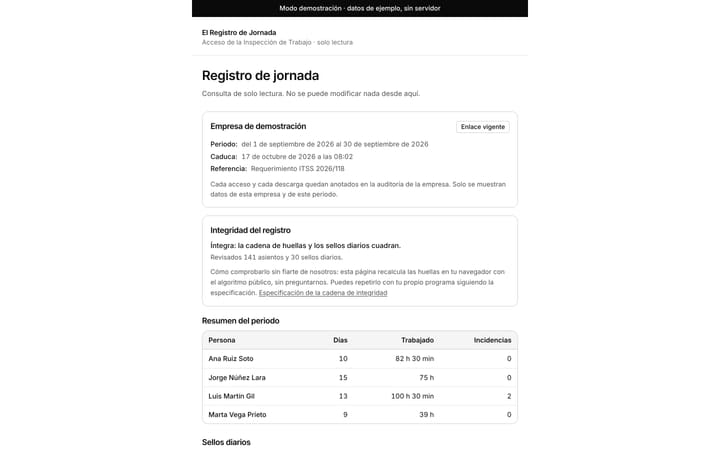
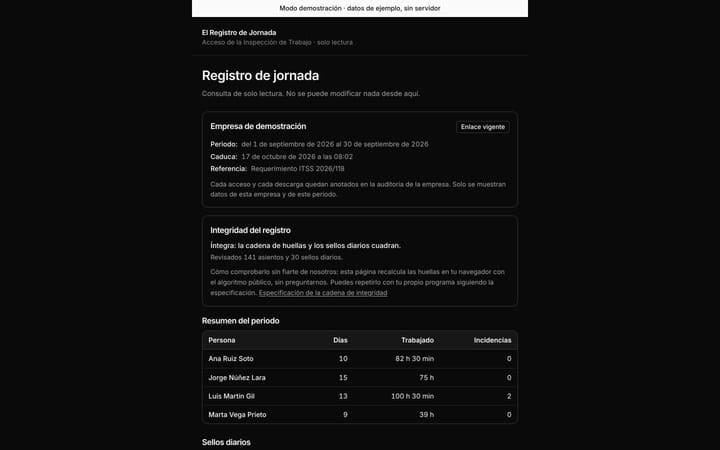
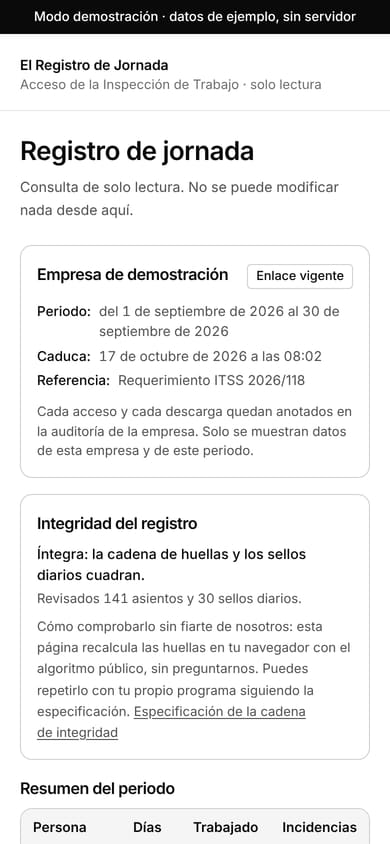
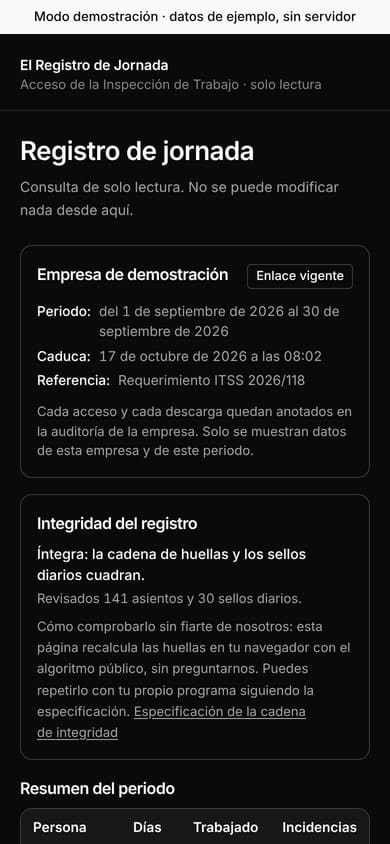
Read-only link for the Inspectorate, with verificationIn demo
Screenshot from the demo, with fictitious data.
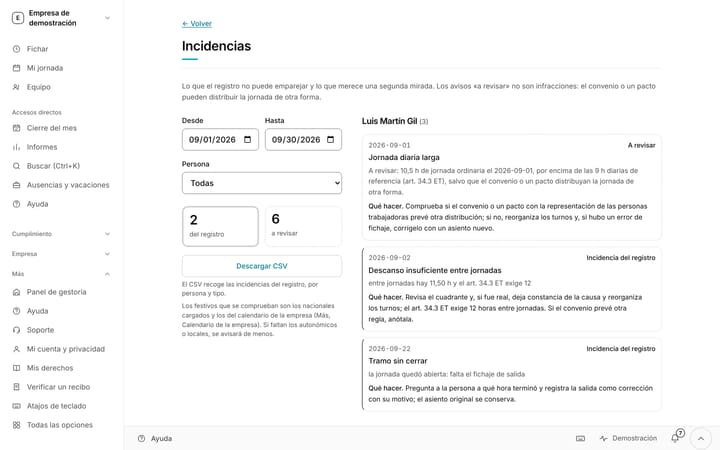
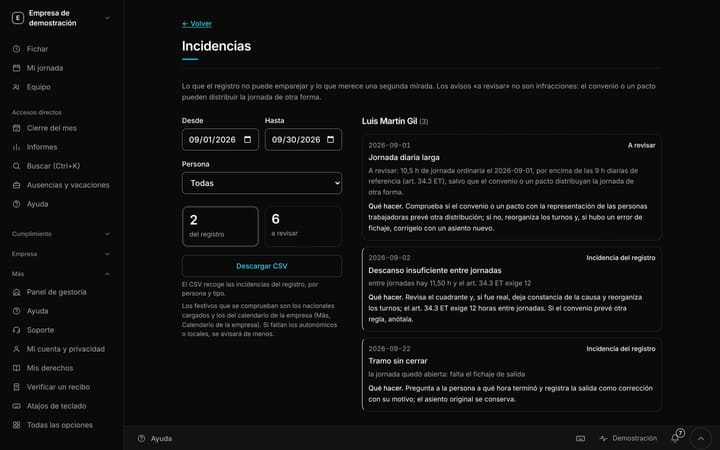
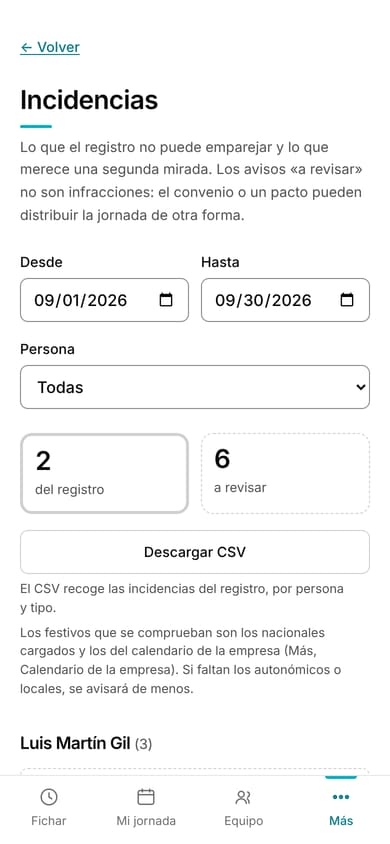
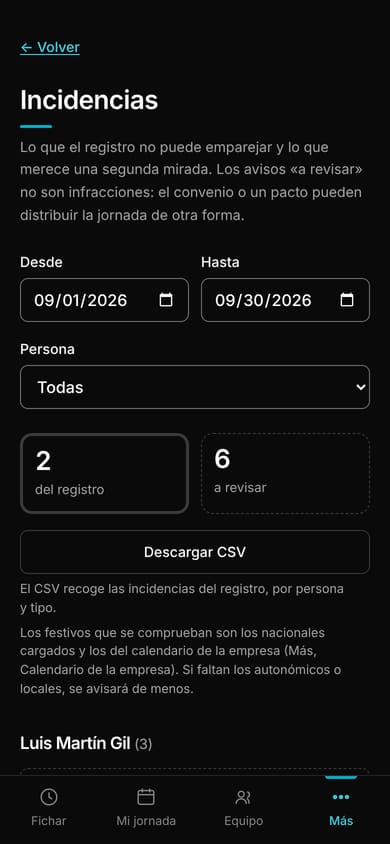
Record incidentsIn demo
Screenshot from the demo, with fictitious data.
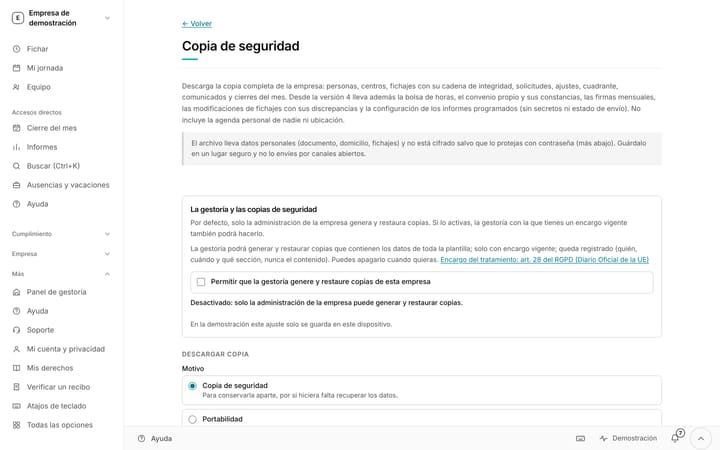
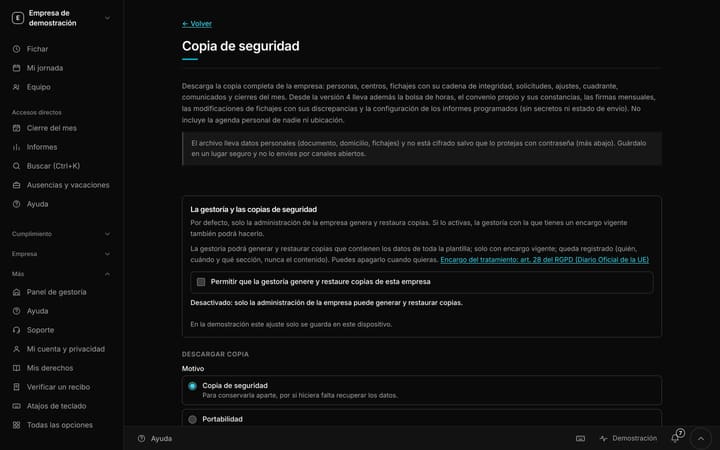
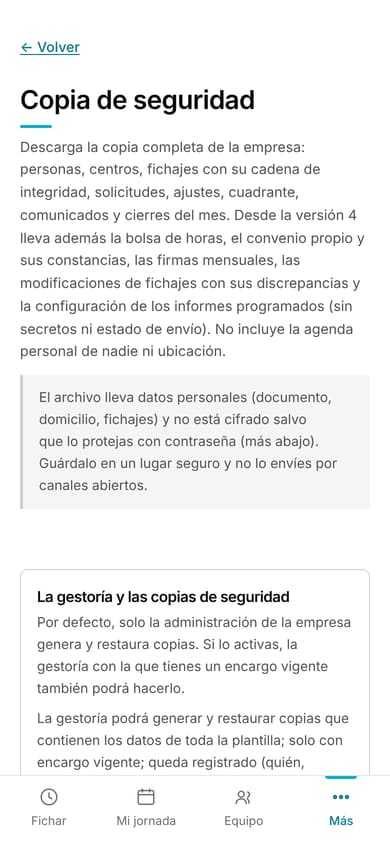
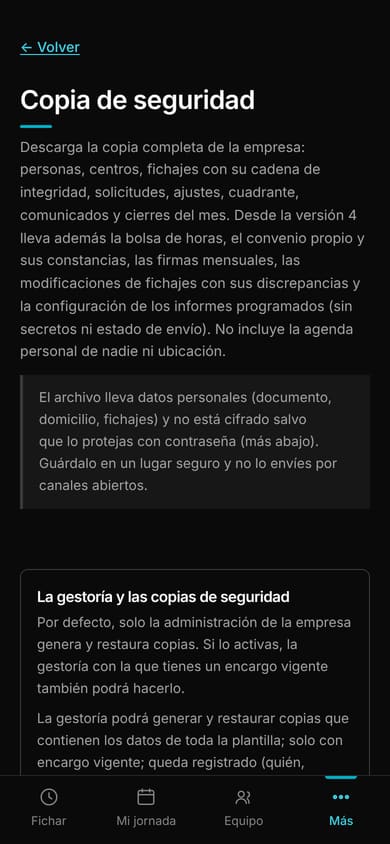
BackupIn demo
Screenshot from the demo, with fictitious data.
Generate a test report this very afternoon
Clock in for a couple of days, download the PDF summary and see whether it is what your advisory firm would ask you for. It is the quickest way to find out whether this is useful to you.