Product
Why a recorded hour cannot be modified
The draft Royal Decree, which is still in the legislative process, asks for the record to be reliable. An “edited by” field is not an indelible trace: it is a note.
Article 2.2 of the draft Royal Decree (in the legislative process) defines what it means for a record to be reliable: that the entries, once made,
cannot be modified without the authorisation of the company and of the worker, and in the event of modification must show a clear and indelible trace of the changes made and of who made them.
Our translation of the quotations from the draft; the official text is in Spanish.
These are two requirements, and both are strong: the approval of both parties is needed, and the trail has to be indelible. A column in a table saying who edited does not offer either, because whoever can write that column can rewrite it.
Here we have solved it the way it is solved in accounting and invoicing: by chaining the entries. It is an idea similar to the chaining of invoicing records in Verifactu.
The four guarantees
What exactly it guarantees you
It cannot be edited
The database rules do not allow an entry to be modified or deleted, not even by the company’s administration. And each entry is chained to the previous one by a SHA-256 hash, with a daily seal: a later change is detected when the chain is verified (there is no electronic signature on each entry).
It cannot be deleted
An entry that has been made stays. Correcting it creates a new one that points to the previous one, and the previous one is still there.
You can tell if someone tries
Each clocking is chained to the previous one with a cryptographic hash. Touching the past breaks the chain and the verification detects it.
It is sealed every night
When the day closes, its signature and the number of entries are stored. That seal is part of the verification package you can download.
How it works
The chain, step by step
- 01
The entry is made
Someone clocks in. The eleven fields of article 3 of the draft regulation are stored and, with them, the signature of the immediately preceding entry of that company.
- 02
Its signature is calculated
A new signature is calculated from the content of the entry and the previous signature. Changing a comma in the past changes that signature and every one that came after it.
- 03
The day is closed
Every night the closing signature is stored, along with how many entries came in. It is the checkpoint that makes it possible to verify a whole period without recalculating everything.
- 04
It can be checked
From the dashboard, anyone with permission recalculates the chain of a period and obtains a report with an integrity seal (it is not a qualified electronic signature). If something does not add up, it says exactly where.
Corrections
Correcting a clocking is not editing it
People forget to clock in. That is normal and it has to be possible to fix it. What cannot happen is for fixing it to mean rewriting the past.
When someone requests a correction, this is what happens:
- A request is opened with the proposed value and the reason.
- The approval of both the company and the worker is needed: whoever opens the request has already given theirs and the other party replies.
- With the agreement of both parties, a new entry is written that refers to the previous one. The original is not touched.
- If there is no agreement, both versions are kept: the company’s and the worker’s disagreement.
That last point is article 4.b of the draft, which is still in the legislative process. A system that keeps only one version of each day cannot record that disagreement. The draft also provides for informing the legal representatives; the company does that communication, the app does not send it.
For the Inspectorate
What you hand over when they ask
The draft asks for the Inspectorate to be able to access “at any time and immediately, remotely and in person”, and for the information to be in a format that is “processable, legible and compatible with those in general use”. It does not go into more detail: the technical detail is left to a ministerial order that does not exist yet.
In the meantime, we offer three things designed for that wording:
- Read-only link with an expiry date, which records who entered and when.
- Full export of the period in CSV, Excel and PDF.
- Verification report of the chain, which lets you check whether the entries have been altered.
When the technical order is published, we will add the format it requires. The architecture is already prepared for it, which was the point.
Ministerio de TrabajoDraft Royal Decree, arts. 2.2, 4.b and 6 (PDF, in Spanish)
Our translation of the quotations from the draft; the official text is in Spanish.
Frequently asked questions
Can the company modify a clocking?
No. The database rules do not allow an entry to be modified or deleted, not even by the company’s administration. Correcting it creates a new entry that points to the previous one, and the previous one is still there.
How is a forgotten clocking corrected?
A request is opened with the proposed value and the reason, and the approval of both the company and the worker is needed. If there is no agreement, both versions are kept: the company’s and the worker’s disagreement.
How do you check that nobody has touched the record?
Each clocking is chained to the previous one with a cryptographic hash and the day is sealed every night. From the dashboard the chain of a period is recalculated and a report with an integrity seal is obtained, which is not a qualified electronic signature.
What the law says
These pages are in Spanish.
How it looks
Screenshots from the demo
Images of the app in demo mode, with a fictitious company and fictitious people. The service is not yet open to the public.
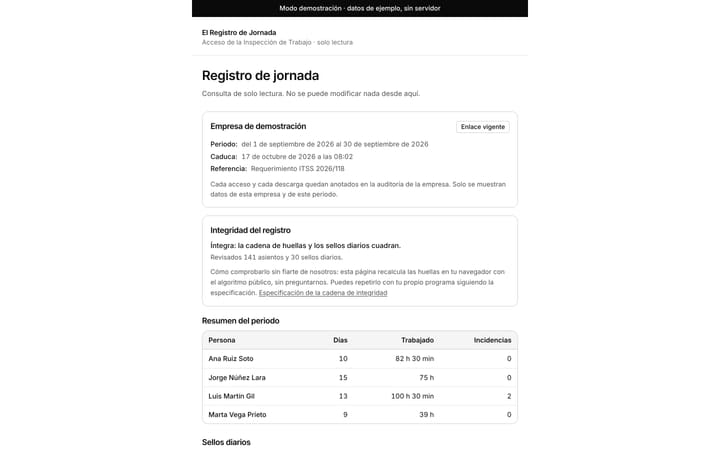
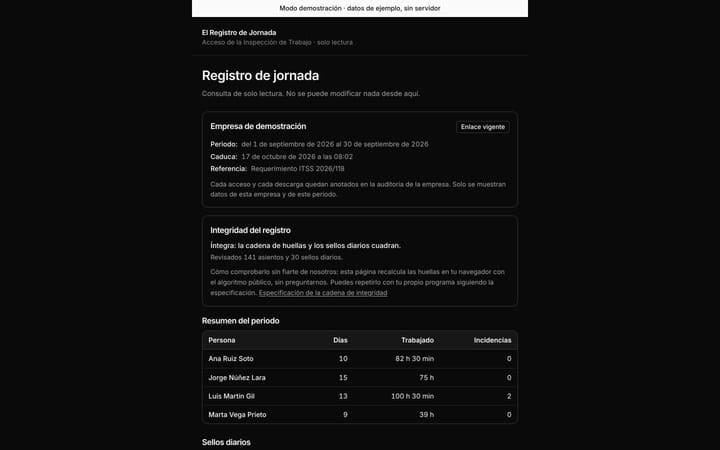
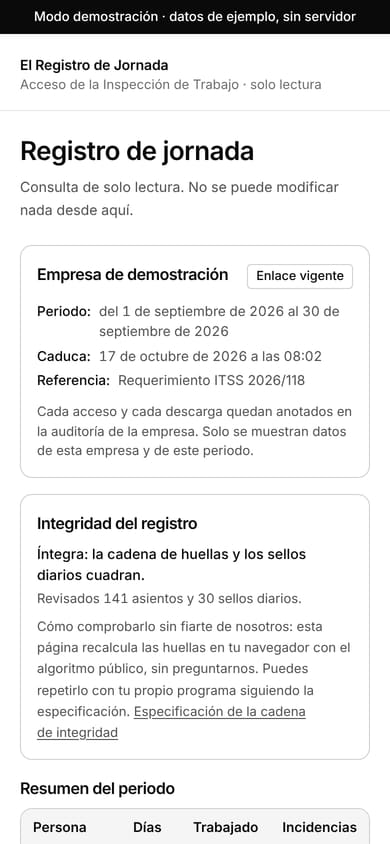
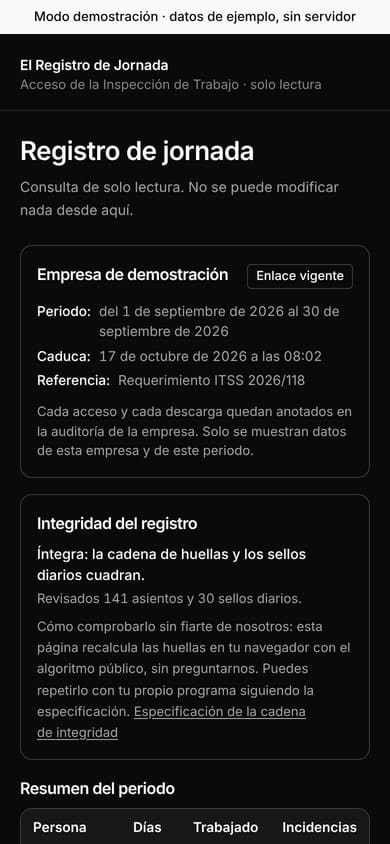
Read-only link for the Inspectorate, with verificationIn demo
Screenshot from the demo, with fictitious data.
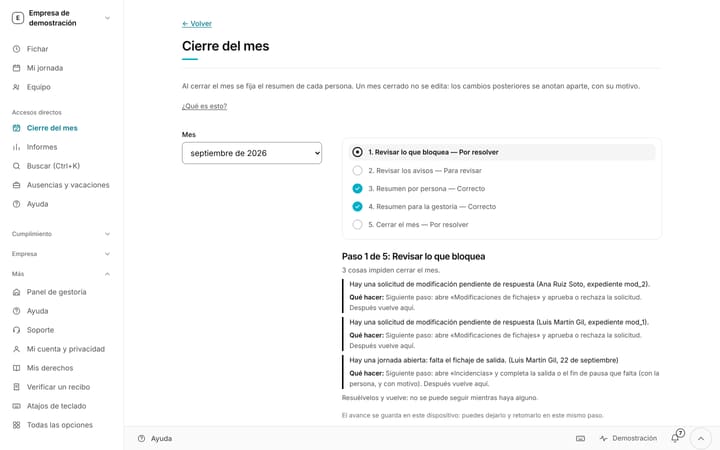
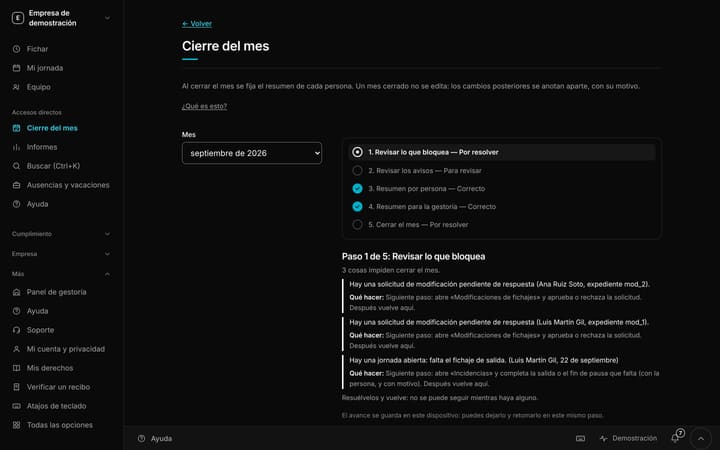
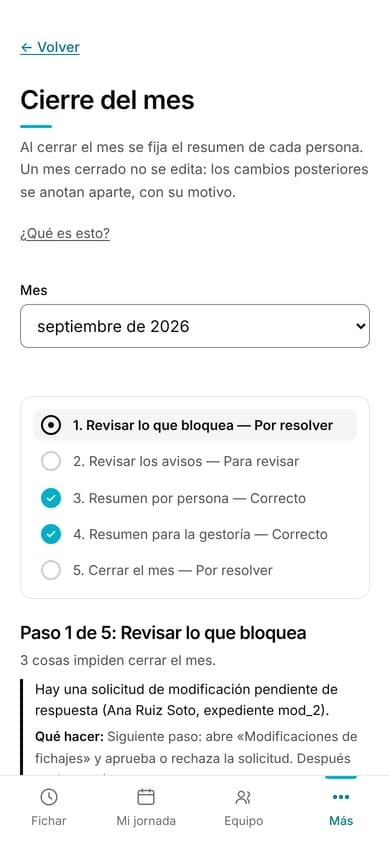
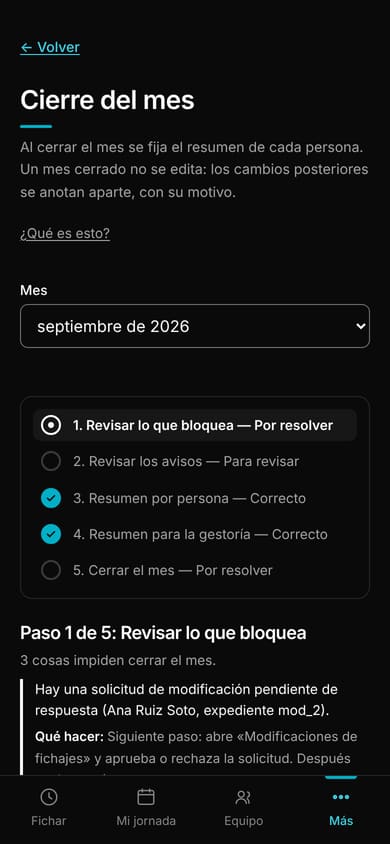
Month-end closing, step by stepIn demo
Screenshot from the demo, with fictitious data.
Check it with your own data
Clock in for a week, correct one day on purpose and download the verification report. It is the quickest way to see the difference.